
Dua for Evil Eye (Nazar): The Prayers the Sheikh Recommends and How to Use Them
The exact dua for evil eye taught in the Sunnah, the surahs that protect, how to recite over a child, and the simple daily routine that keeps nazar away.
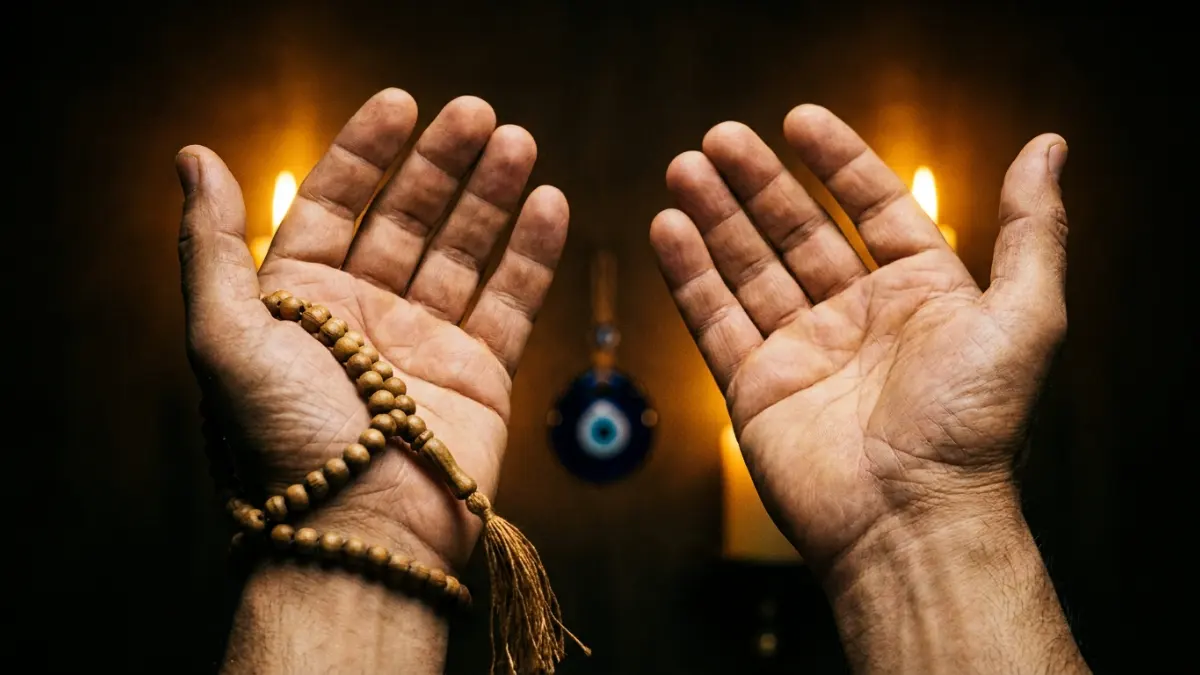
You suspect the eye has touched you or your child, and you want the right words, not a hundred forum opinions. The good news is that the dua for evil eye is not a secret. The Prophet ﷺ taught specific prayers for protection from nazar, and they are short enough to learn tonight. This guide gives you the duas, the surahs, how to recite them over a child or over yourself, and the daily routine the Sheikh recommends so that protection becomes a habit rather than an emergency.
Quick answer
The main dua for evil eye is the one the Prophet ﷺ used for Hasan and Husayn: U’idhukuma bi kalimatillahit-tammah, min kulli shaytanin wa hammah, wa min kulli ‘aynin lammah (“I seek protection for you both in the perfect words of Allah from every devil and harmful creature and every evil eye”). Pair it with Ayat al-Kursi, Surah al-Falaq, an-Nas and al-Ikhlas morning and evening, and always say mashallah when admiring something.
In this guide
The dua for evil eye from the Sunnah
The Prophet ﷺ used to seek protection for his grandsons with these words, and taught that Ibrahim (Abraham) used them for Isma’il and Ishaq. It is the first dua to learn:
Arabic: أُعِيذُكُمَا بِكَلِمَاتِ اللَّهِ التَّامَّةِ، مِنْ كُلِّ شَيْطَانٍ وَهَامَّةٍ، وَمِنْ كُلِّ عَيْنٍ لَامَّةٍ
Transliteration: U’idhukuma bi kalimatillahit-tammah, min kulli shaytanin wa hammah, wa min kulli ‘aynin lammah.
Meaning: “I seek protection for you both in the perfect words of Allah, from every devil and every harmful creature, and from every evil eye.”
For one person, say u’idhuka (male) or u’idhuki (female) instead of u’idhukuma. For yourself, say a’udhu (“I seek refuge”). The meaning does not change.
A second dua, from the hadith of Jibril (Gabriel) treating the Prophet ﷺ, is the classic formula for ruqyah:
Transliteration: Bismillahi arqika, min kulli shay’in yu’dhika, min sharri kulli nafsin aw ‘aynin hasidin, Allahu yashfika, bismillahi arqika.
Meaning: “In the name of Allah I perform ruqyah for you, from everything that harms you, from the evil of every soul or envious eye, may Allah heal you, in the name of Allah I perform ruqyah for you.”
The surahs and verses that protect from nazar
Alongside the duas, the tradition relies on a small set of verses. They are short, they are in every Quran, and the Prophet ﷺ recited them for himself every night. Many also recite the last two verses of Surah al-Baqarah each night, and our guide explains their place in the Sunnah.
| Recitation | When | Why it is used |
|---|---|---|
| Ayat al-Kursi (2:255) | After each prayer and before sleep | The hadith says whoever recites it before sleeping has a guardian from Allah until morning. More on Ayat al-Kursi. |
| Surah al-Ikhlas, al-Falaq, an-Nas | Three times, morning and evening | Al-Falaq explicitly asks refuge “from the evil of an envier when he envies”. The Prophet ﷺ blew into his hands and wiped his body after reciting them. |
| The last two verses of al-Baqarah | Every night | The hadith says they suffice whoever recites them at night. |
| Surah al-Fatihah | During ruqyah | Called “the cure” in the hadith; the companions used it to treat the afflicted. |
| Surah al-Qalam 68:51 | During ruqyah for the eye | The verse describing those who “almost strike you down with their eyes”. |
Said properly, with attention and trust in God, these are the whole of the traditional protection. The tradition adds nothing hidden to them. For how they fit into a full treatment, see our ruqyah guide.
How to recite the dua over a child or over yourself
People worry about doing this “correctly”. The method is simple and the same whether it is for a baby, an adult or yourself.
- Make wudu if you can. It is not a condition, but it settles the heart and is the Sunnah.
- Put your right hand on the person (on a child’s head or chest) or on your own chest.
- Recite the dua for evil eye above, then Ayat al-Kursi, al-Ikhlas, al-Falaq and an-Nas, each three times.
- Blow gently (a light breath with a little moisture) over the person or into your palms, then wipe over the face and body. This is what the Prophet ﷺ did.
- Repeat morning and evening for at least a week, and whenever symptoms appear.
- Say mashallah, tabarakallah out loud whenever you or others admire the child, the home or the blessing.
You may also recite over water (Zamzam or ordinary clean water), then drink it and sprinkle or wash with it. This is well established in the tradition. What you should not do is add words, numbers, knots or objects that were never part of the Sunnah; that is where protection turns into something else. Our article on taweez explains where the line sits.
If the dua does not seem to be working
Three things usually explain it. First, the problem is not the eye: it may be ordinary illness, stress, or a different spiritual cause such as envy-driven magic, which needs a different approach. Second, the recitation has become mechanical, rushed and without presence; the words matter, but so does the heart behind them. Third, the source is still active: someone close keeps looking with envy, and the tradition’s strongest remedy is to ask that person to perform the washing (ghusl) whose water is then poured over the afflicted.
If after one to two weeks of sincere recitation nothing changes, do not keep guessing. Compare your situation with the signs of black magic, and if you are unsure which it is, describe it plainly on the consultation page. A clear diagnosis saves months of repeating the wrong remedy.
Not sure what you’re dealing with?
Describe your situation to Sheikh Kamal Elhidi. He reads every message himself — free, private, and with no obligation.
How the Sheikh approaches it
The Sheikh’s first question is always about the pattern: when did it start, what was praised or seen just before, and does the person yawn, feel heavy or weep during recitation. Those details tell him whether this is the eye, something heavier, or nothing spiritual at all.
For the eye he prescribes exactly what is above, with a routine fitted to the family: which recitations, how many times, over whom, and for how long. Where the source is known, he explains how to ask for the washing without accusing anyone or breaking family ties. He does not sell objects, and he does not add anything to the Sunnah.

About the Sheikh. Sheikh Kamal Elhidi is a practitioner of traditional ruqyah and spiritual diagnosis. Every article on this guide is written with his direct guidance and reviewed with him before publishing. Learn more about the Sheikh and how he works.
Carrying a worry about envy or the evil eye? After the du’as and verses above, some readers like a calm, personal moment to reflect on the people and situations that weigh on them. Our partner PuraTarot offers a Grounding and Personal Boundaries Ritual for exactly that, a personal reflection, not a diagnosis or a treatment. For the spiritual side, follow the steps above and the Sheikh’s guidance. Join the free Curse Removal Guide newsletter and, once you confirm, you will unlock a 50% code for your first PuraTarot session.
Frequently asked questions
What is the dua for evil eye?
The dua the Prophet ﷺ used for his grandsons: “U’idhukuma bi kalimatillahit-tammah, min kulli shaytanin wa hammah, wa min kulli ‘aynin lammah”, meaning “I seek protection for you both in the perfect words of Allah from every devil, harmful creature and evil eye.” Change the pronoun for one person or for yourself.
Which surah protects from nazar?
Surah al-Falaq is the clearest, since it asks refuge from the envier. The tradition pairs it with al-Ikhlas and an-Nas three times morning and evening, plus Ayat al-Kursi after prayer and before sleep.
Can I read the dua for evil eye for myself?
Yes. Say “a’udhu” (I seek refuge) instead of “u’idhuka”, place your hand on your chest, recite the surahs, blow into your palms and wipe over your body, as the Prophet ﷺ did every night.
How do I protect my baby from the evil eye?
Recite the dua over the child morning and evening with your hand on their head, keep Ayat al-Kursi and the three surahs, and say mashallah whenever the baby is admired. Avoid posting constant photos for strangers, and ask visitors to say mashallah.
Is a nazar bead or evil eye bracelet enough protection?
No. The bead is a cultural symbol with no power of its own, and relying on it is discouraged in Islam. Real protection is the daily recitation and remembrance; if you wear a bracelet, treat it as a reminder, not a shield.
Further reading
- Fortress of the Muslim (Hisn al-Muslim): Morning, evening and daily du’as from the Sunnah, with sources.
- Healing with the Medicine of the Prophet: Ibn Qayyim al-Jawziyya on Prophetic remedies, including recitation and the evil eye.
- The Clear Quran: A readable English translation by Dr. Mustafa Khattab for the verses above.
As an Amazon Associate we earn from qualifying purchases.
What the Sheikh usually prescribes for this
There is no single remedy that fits every case — the same signs can come from the evil eye, from sihr, or from nothing spiritual at all. That is why Sheikh Kamal Elhidi always asks about your situation first, then tells you plainly what he sees and what he would do.
If you would like his view on your own case, describe it below. He reads every message himself — free, private, and with no obligation.
Reader reviews
Did this guide help you? Leave a short, honest review so other readers know what to expect. Reviews are checked before they appear.
There are no reviews yet. Be the first one to write one.


