
Hamsa Hand Meaning: The Hand of Fatima, the Evil Eye and What Islam Actually Says
The open hand with the eye in the palm is everywhere, and almost nobody knows what it means. Here is the hamsa hand meaning, the story of the hand of Fatima, how it relates to the evil eye, what the positions and colors stand for, and what Islam says about wearing it.
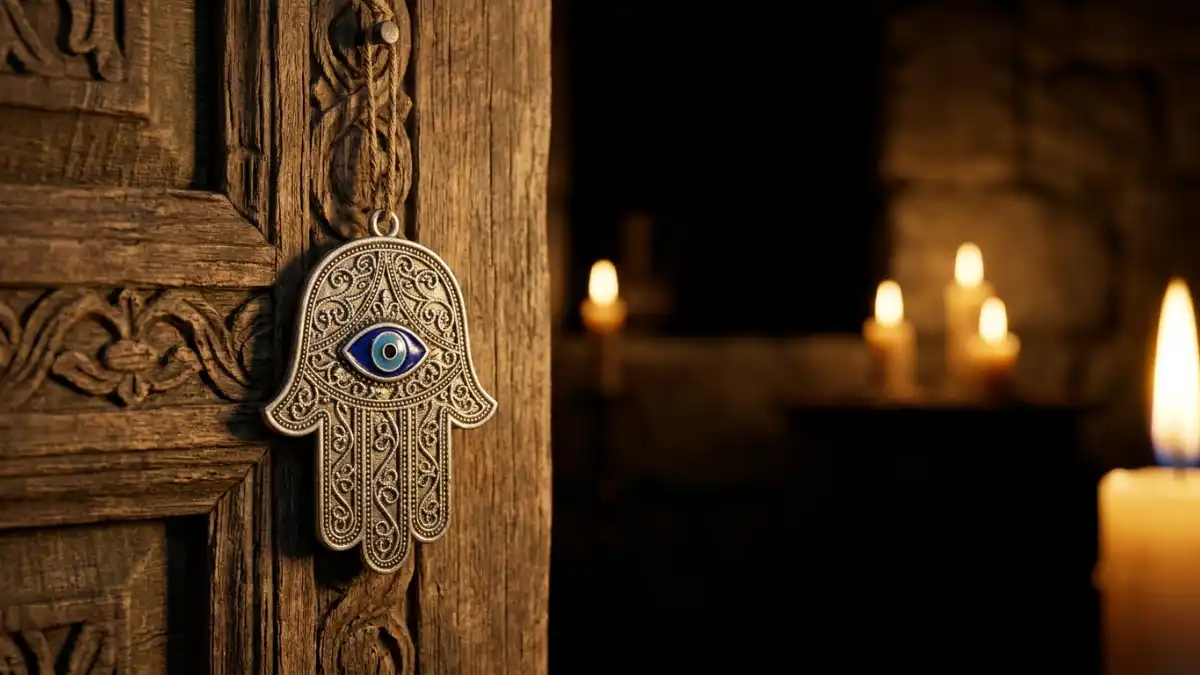
You have seen it on doorways in Morocco, necklaces in New York and phone cases everywhere: an open hand, five fingers, often with an eye in the palm. Someone called it the hand of Fatima, someone else said it was Jewish, and the shop said it brings luck. The hamsa hand meaning is older and more interesting than any of those answers, and if you are Muslim, there is also a straight answer to whether you should wear one. This guide gives the meaning, the history, the symbolism of the positions and colors, the link to the evil eye, and the Islamic view.
Quick answer
The hamsa (khamsa, “five” in Arabic) is an open right hand, often with an eye in the palm, used across the Middle East and North Africa as protection against the evil eye. Muslims call it the hand of Fatima, Jews the hand of Miriam, Christians the hand of Mary; it predates all three. Fingers up is said to ward off harm, fingers down to invite blessing. In Islam the symbol is a cultural charm with no power of its own; relying on it for protection is discouraged, and real protection comes from remembrance of God.
In this guide
What the hamsa means
The word is simply the Arabic khamsa, five, for the five fingers. The symbol is a stylised open palm, usually symmetrical, with the thumb and little finger the same shape, and very often an eye set in the centre. Its one consistent meaning across every culture that uses it is protection against the evil eye: the envious glance that is believed to bring harm. The open hand says “stop”; the eye in the palm looks back at the one who looks.
Everything else layered on it, luck, fertility, strength, blessing, femininity, came later and varies by region. If you want the core, it is this: the hamsa is a shield against envy, and it is the sister of the blue nazar bead, which does the same job with the eye alone.
The history: hand of Fatima, hand of Miriam, hand of Mary
The open hand as a protective symbol goes back at least to ancient Mesopotamia and to Carthage, where it was associated with the goddess Tanit, long before Islam, Christianity or rabbinic Judaism gave it their own names. Each of the three traditions later adopted it and attached a beloved woman to it.
| Tradition | Name | Story attached to it |
|---|---|---|
| Islamic (North Africa, Middle East) | Hand of Fatima (khamsa) | Named after Fatimah, the daughter of the Prophet ﷺ; the five fingers are sometimes said to recall the five pillars or the five members of the Prophet’s household |
| Jewish (especially Sephardic and Mizrahi) | Hand of Miriam | Named after Miriam, sister of Moses; the five fingers recall the five books of the Torah; widely used in Jewish homes and jewellery |
| Christian (Levant, Mediterranean) | Hand of Mary | Associated with the Virgin Mary; less common, mainly in the Eastern Mediterranean |
| Pre-Islamic North Africa and Mesopotamia | The hand of Tanit, the open hand | Protective hand symbols on amulets and walls thousands of years before any of the above |
So it is accurate to say the hamsa is Islamic, Jewish and Christian, and more accurate to say it is older than all of them and was adopted by each. The name “hand of Fatima” is a Muslim folk name, not a religious teaching, and it is important to know that Fatimah herself has nothing to do with amulets.
Hamsa up or down, and what the colors mean
Folk tradition reads the orientation and the color, and jewellers have made the readings widely known. None of this is scripture, but it is what people mean when they choose one.
- Fingers pointing up: a shield. It is said to ward off the evil eye, envy and negative energy. This is the traditional protective position, often with the eye in the palm.
- Fingers pointing down: an open hand receiving. It is said to welcome blessing, abundance and answered prayers, and to invite good rather than block harm.
- Blue: the classic protective color, as with the nazar bead.
- Red: courage, love and protection in relationships.
- Green: health, growth and new beginnings.
- White: purity, clarity, fresh starts.
- Gold: prosperity and success.
If you are choosing one as jewellery or decoration, choose by what you like. The next section explains why, for a Muslim, the color and position are not where the protection comes from.
What Islam says about the hamsa and the evil eye
Islam confirms that the evil eye is real; the Prophet ﷺ said so plainly, and Surah al-Falaq teaches us to seek refuge from the envier. What Islam does not do is attach the protection to an object. The Prophet ﷺ said that whoever hangs an amulet (tamimah) has associated something with God, and in another report asked that an amulet be cut from a man’s arm, saying it would only increase him in weakness. The scholars read these to forbid relying on charms as a source of protection, and many of them considered wearing the hamsa or the nazar for protection to be impermissible for exactly that reason.
That leaves a narrow space. A hand-shaped pendant worn purely as decoration or as a cultural keepsake, with no belief that it does anything, is treated more leniently by many scholars, though some advise avoiding it altogether so as not to resemble those who rely on it. The practical advice the Sheikh gives is simple: if it is on your wall because your grandmother’s was, keep it as a memory; if it is there because you think it stops the eye, take it down and learn what actually does.
What actually does is free and in every Quran: saying mashallah when you admire something, the morning and evening adhkar, Ayat al-Kursi and the three surahs, and the specific duas for the evil eye. If you think the eye has already touched you, no hand on the wall will lift it; the method in how to remove evil eye will. For the broader comparison of charms, prayers and what a Sheikh relies on, read evil eye protection, and if you are unsure what you are dealing with, describe it to Sheikh Kamal Elhidi on the consultation page.
Not sure what you’re dealing with?
Describe your situation to Sheikh Kamal Elhidi. He reads every message himself — free, private, and with no obligation.
How the Sheikh approaches it
The Sheikh is asked about the hamsa constantly, usually by people who were given one and feel uneasy about it. His answer is gentle and clear: the hand is heritage, not protection, and keeping it as heritage is one thing while trusting it is another. He never shames a family for the hand on the wall.
Then he turns to what matters. If the person is worried about the eye, he asks what has actually been happening, and if there is a pattern that fits the eye or something heavier, he prescribes the traditional recitations and routine. He does not sell charms, and he does not tell anyone that an object will keep them safe.

About the Sheikh. Sheikh Kamal Elhidi is a practitioner of traditional ruqyah and spiritual diagnosis. Every article on this guide is written with his direct guidance and reviewed with him before publishing. Learn more about the Sheikh and how he works.
Curious what this symbol stirs up in your own life? Our partner PuraTarot offers a full personal reflection session, the Full Personal Reading, a quiet space to think about your feelings, your choices and what you would like to change. It is a personal reflection, not a diagnosis or a treatment, so for the spiritual side, follow the guidance above and the Sheikh’s counsel. Join the free Curse Removal Guide newsletter and, once you confirm, you will unlock a 50% code for your first PuraTarot session.
Frequently asked questions
What does the hamsa hand mean?
The hamsa, from the Arabic khamsa meaning five, is an open hand, often with an eye in the palm, used across the Middle East and North Africa as protection against the evil eye. Later meanings such as luck, blessing and fertility were added by different cultures.
Why is the hamsa called the hand of Fatima?
Muslims in North Africa and the Middle East named it after Fatimah, the daughter of the Prophet ﷺ, as a folk name. Jews call the same symbol the hand of Miriam and Christians the hand of Mary. The symbol itself is older than all three religions.
What is the difference between the hamsa and the evil eye?
The evil eye is the harmful envious glance; the nazar bead and the hamsa are both charms meant to deflect it. The nazar is the eye alone; the hamsa is the open hand, often with the eye set in the palm. They are usually worn for the same purpose.
Is it haram to wear a hamsa in Islam?
Wearing it as protection from the evil eye is discouraged and considered impermissible by many scholars, because the Prophet ﷺ forbade amulets and taught that protection comes from God alone. Wearing or displaying it purely as decoration or heritage is treated more leniently, though some scholars advise avoiding it altogether.
Does the hamsa hand actually protect you?
In the Islamic view, no. The hand has no power of its own; the evil eye is real but the protection against it is saying mashallah, the daily adhkar, Ayat al-Kursi, the three surahs and the duas taught by the Prophet ﷺ.
Further reading
- The Evil Eye: A Casebook: Alan Dundes’s collection of scholarly essays on the evil eye across cultures.
- Healing with the Medicine of the Prophet: Ibn al-Qayyim on Quranic and Prophetic healing, including the evil eye and sihr.
- Fortress of the Muslim (Hisn al-Muslim): Authentic supplications from the Quran and Sunnah for morning, evening and daily life.
As an Amazon Associate we earn from qualifying purchases.
What the Sheikh usually prescribes for this
There is no single remedy that fits every case — the same signs can come from the evil eye, from sihr, or from nothing spiritual at all. That is why Sheikh Kamal Elhidi always asks about your situation first, then tells you plainly what he sees and what he would do.
If you would like his view on your own case, describe it below. He reads every message himself — free, private, and with no obligation.
Reader reviews
Did this guide help you? Leave a short, honest review so other readers know what to expect. Reviews are checked before they appear.
There are no reviews yet. Be the first one to write one.


